'%3ECASH%3C/text%3E%3C/svg%3E)

















The shoes communicate before the wearer has spoken. In any context where the observers have learned to read signals — which includes most professional environments above a certain level of seniority — the shoes are often the first element of dress that provides information not readily available from everything else the wearer is wearing. The reason is economic: as the cost barrier to appearing correctly dressed above the ankle has declined materially with the rise of accessible luxury and fast fashion, the shoe has become one of the last reliable differentiators between genuine investment in presentation and the appearance of it. A person who has assembled a credible wardrobe through volume and visible branding will frequently reveal themselves through footwear that has not received the same attention. The room notices, largely below conscious awareness, and the impression is formed before the conversation has begun.
What Shoes Actually Communicate

The specific communication depends entirely on context. In a law firm, investment bank, or management consulting environment in London or New York, a Goodyear-welted black cap-toe oxford in calf from a recognised British maker communicates fluency in the dress code of the room — that the wearer understood the room well enough to dress for it and made the specific investment that understanding requires. In a technology or creative environment that has deliberately rejected formality as a cultural signal, the same shoe may communicate a different message — either sophisticated irony or miscalibrated formality, depending on execution and confidence. The shoe is always contextual. The failure mode in either direction is not the wrong shoe in isolation — it is the right shoe for the wrong room, executed without the social awareness to know the difference.
Condition communicates more than style within any category. A well-worn shoe that has been correctly maintained — polished regularly with appropriate cream and wax, stored on cedar shoe trees, resoled when the welt begins to show wear — communicates specific things about the wearer's relationship with quality: they understand the economics of buying better and maintaining it rather than buying repeatedly. A luxury designer sneaker in pristine condition communicates a different set of values — status through novelty and price visibility rather than through longevity and maintenance. Neither is objectively correct; both communicate precisely what they intend to the audience that knows what to look for.
The Hierarchy of Men's Dress Shoes
The Goodyear welt construction — in which the upper leather is stitched to a strip of leather (the welt) that is then stitched to the outsole, allowing the outsole to be replaced without disturbing the upper — is the standard of quality in dress shoes because it allows the shoe to be resoled indefinitely. A well-made Goodyear-welted shoe will outlast four or five shoes made by other construction methods: Blake stitching (upper stitched directly to the outsole through the insole — can be resoled once or twice at most by a specialist); Stitch-down construction (a variation with limited resole potential); cemented construction (upper glued to the outsole, cannot be resoled).
Within dress shoe styles, formality decreases in approximately this order: cap-toe oxford (the most formal, appropriate in any context requiring a dress shoe); plain-toe oxford; plain-toe derby (open lacing, slightly less formal, more comfortable for wider feet); monk strap (single or double, fashion-forward, not appropriate in very conservative environments); tassel or penny loafer (casual end of the dress shoe spectrum, works with suits in relaxed professional contexts and with chinos in most others). The cap-toe black oxford is the only shoe in this hierarchy that is simultaneously appropriate in every formal context and invisible in every professional context — it attracts no attention and sends no unintended signals. All other options involve a trade-off between versatility and expression.
The Makers That Matter and Why

Northampton, England, has been the centre of British quality shoe production since at least the 14th century, when the town's access to leather tanning infrastructure and its location on the major trade routes made it the natural manufacturing centre for the English boot and shoe trade. Church's was established in Northampton in 1873; Crockett & Jones in 1879 (still independent, still family-owned); Edward Green in 1890 (still independent); John Lobb's London workshop (separate from the Hermès-owned Paris house) in 1866. These makers share the same fundamental approach: Goodyear welt construction on their main lines, upper leather from documented English and French tanneries, last-making in-house, and hand-finishing processes that have not changed materially in a century.
Entry-level ready-to-wear from Crockett & Jones starts at approximately £450; Edward Green at approximately £900; John Lobb bespoke at approximately £5,000 per pair for a first commission (with a wooden last made to the customer's foot retained for all subsequent orders). For buyers not yet at the bespoke stage, Crockett & Jones represents the strongest combination of quality, heritage, and accessible pricing in the Northampton maker category. American equivalent: Alden, based in Brockton, Massachusetts, since 1884, producing Goodyear-welted shoes using American shell cordovan and calf at prices comparable to entry-level Northampton makers.
Maintenance: The Part Most People Skip
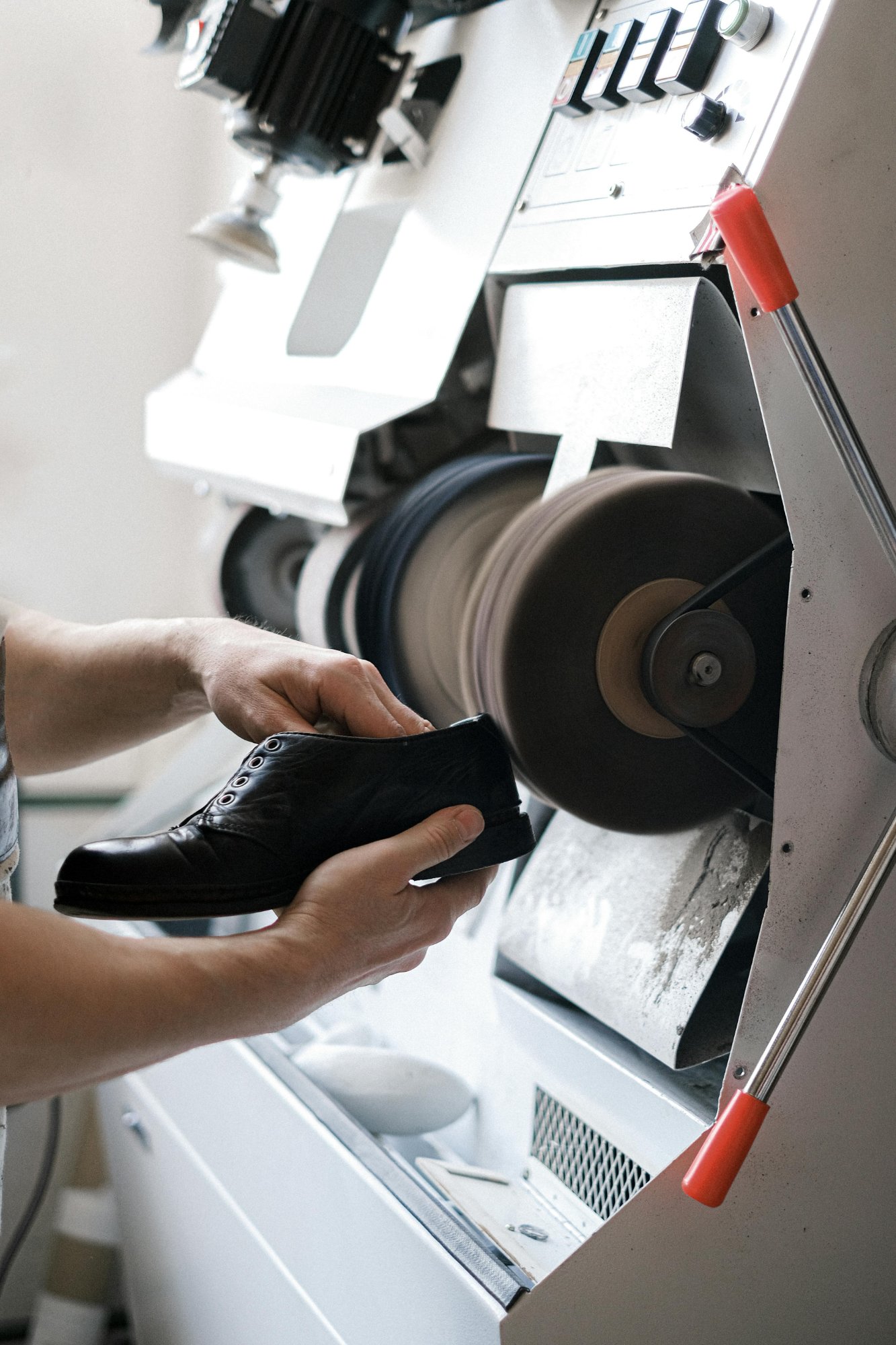
A quality leather shoe maintained incorrectly will perform no better than a cheap shoe within two to three years. The maintenance protocol is straightforward and requires approximately ten minutes per pair per week of active wear: alternate shoes on different days (leather requires 24–48 hours to dry completely and recover its shape after a full day of wear — wearing the same pair daily accelerates breakdown); insert cedar shoe trees immediately after removing the shoe (cedar absorbs moisture, maintains the toe box shape, and inhibits bacterial growth that causes odour and leather degradation); remove surface dirt with a slightly damp cloth before applying any polish; apply leather cream polish to nourish and condition the leather, not just to produce shine; apply wax polish over the cream for water resistance and surface protection; buff with a horsehair brush. Full resoling at a quality cobbler — not a chain shoe repair shop, where the replacement soles are typically inferior synthetic compounds — is appropriate when the welt begins to show wear through the stitching, typically every 12–18 months for a daily-worn shoe.
Cedar shoe trees cost approximately £25–£40 per pair from quality sources. They are non-negotiable for quality leather shoes. Their absence is the single most reliable indicator that the owner does not understand the economics of shoe maintenance — and the absence of that understanding will produce visible results on the shoe within 18 months of regular use.
Sources: Northampton Borough Council shoemaking heritage documentation; Crockett & Jones company history and pricing (established Northampton 1879); Church's company history (established Northampton 1873); Edward Green company history (established Northampton 1890); John Lobb London company history (established London 1866); Alden Shoe Company history (established Brockton, Massachusetts, 1884). This article is editorial commentary only. Pricing is subject to change.